Interactions across EU Green Deal Criteria: the Tisza floodplain rewetting demonstration case study
Further detailed narrative reports on these interactions and their implications for future restoration planning are provided in MERLIN Deliverable 1.6, pages 19–23.
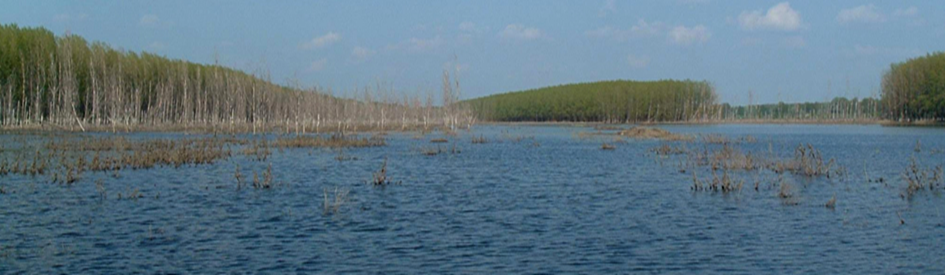
The Tisza Floodplain Restoration case study is a MERLIN Demonstration Site located near the village of Nagykörű on the Central part of the Tisza River, Hungary; the largest sub-basin of the Danube River Basin. The restoration activities for this Demonstration Case formed part of the LIFE00-NAT-A-7051 Project implemented between 2001–2005. The beneficiary was WWF Austria, the project partner was WWF Hungary. The main aim of this project was to restore and conserve floodplain-related habitats (e.g. Figure 1), targeting 5 sites, which are situated along the middle section of the Tisza River in Hungary, within the “Middle Tisza Landscape Protected Area”.
The results of the aggregated Assessment are provided (Figure 2) alongside an analysis of interactions between impacts of the restoration actions provided by the Case Study Reporting Team. The measures were assessed as having positive effects on Biodiversity Net Gain, Climate Regulation (with low confidence), Flood and Drought Resilience, Health and Wellbeing, Circular Economies and Financing the Transition. Negative effects were assessed to have resulted from the implementation of measures only for the Farm to Fork Criterion. A range of interactions were identified between criteria and the contexts underpinning these are introduced in the narratives below for relevant EGD Criteria.

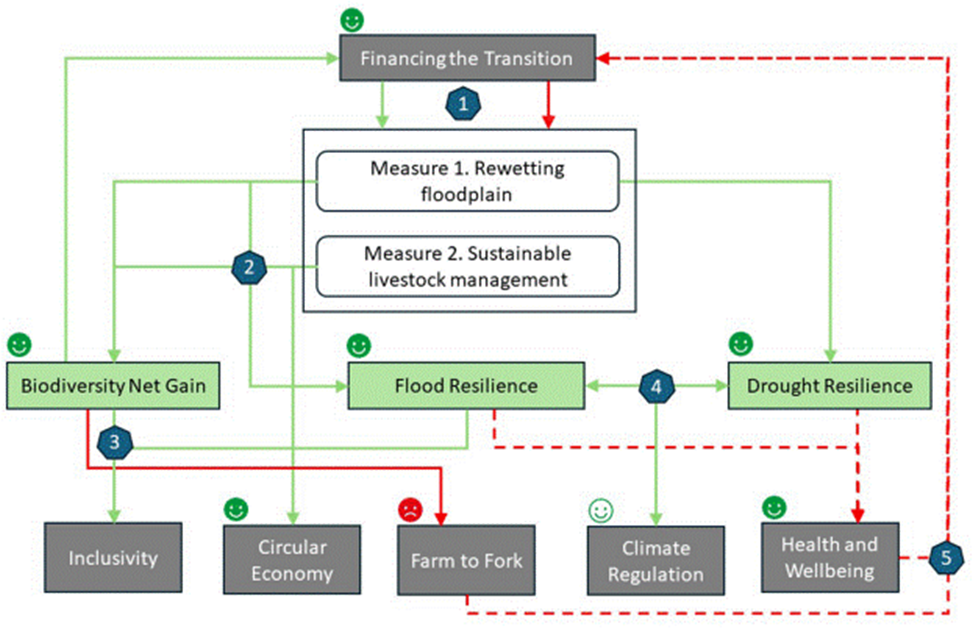
- Interaction 1: Stable funding essential for sustaining multiple benefits. Funding issue leading to inefficient control of the sluice leading to drying of the lake leading to reduced flood and drought resilience, ingress of invasive species, and a drop in public engagement activities which were viewed as important in achieving stakeholder buy-in.
- Interaction 2. Combined measures delivering simultaneous multiple benefits. The restoration of sluice gates ad lake creation over the period of a decade and a half have transformed land-use in the area. The measures have supported the establishment of vegetation and habitats close to natural floodplain conditions delivering biodiversity gains, enhancing flood and drought management, and providing biofuel for local power generation.
- Interaction 3. Bringing people to nature enhances inclusivity and reinforces restoration. Restoration increased access to nature and established routes for nature walks in the area. The restoration efforts received high media attention during the period of funding for the LIFE project (i.e. between 2001–2006). Highlights in the media included improved aesthetic condition for the public associated with grassland restoration and biodiversity conservation.
- Interaction 4. Floods, droughts, and climate regulation. The installation of the sluice allowed for controlled water retention following flooding of the Tisza above 600 cm, mainly in the winter-spring period when appropriately managed. The floodplain restoration is predicted to have had a positive impact on NGB, where wetting increases biomass production and habitat condition leading to reduced greenhouse gas emissions and increased carbon sequestration.
- Interaction 5. Land-use change risks stakeholder dissatisfaction. Generally, the restoration project is perceived by stakeholders to have supported more sustainable agricultural practices. However, some stakeholders consider the loss of agricultural land during water retention in Lake Anyita as a negative effect. The perceived risk from breeding mosquito populations in standing water is also a cause for stakeholder concern.