MERLIN restoration Case Study Assessments
Read: Manuscript and policy briefing evaluating success of large landscape-scale restoration
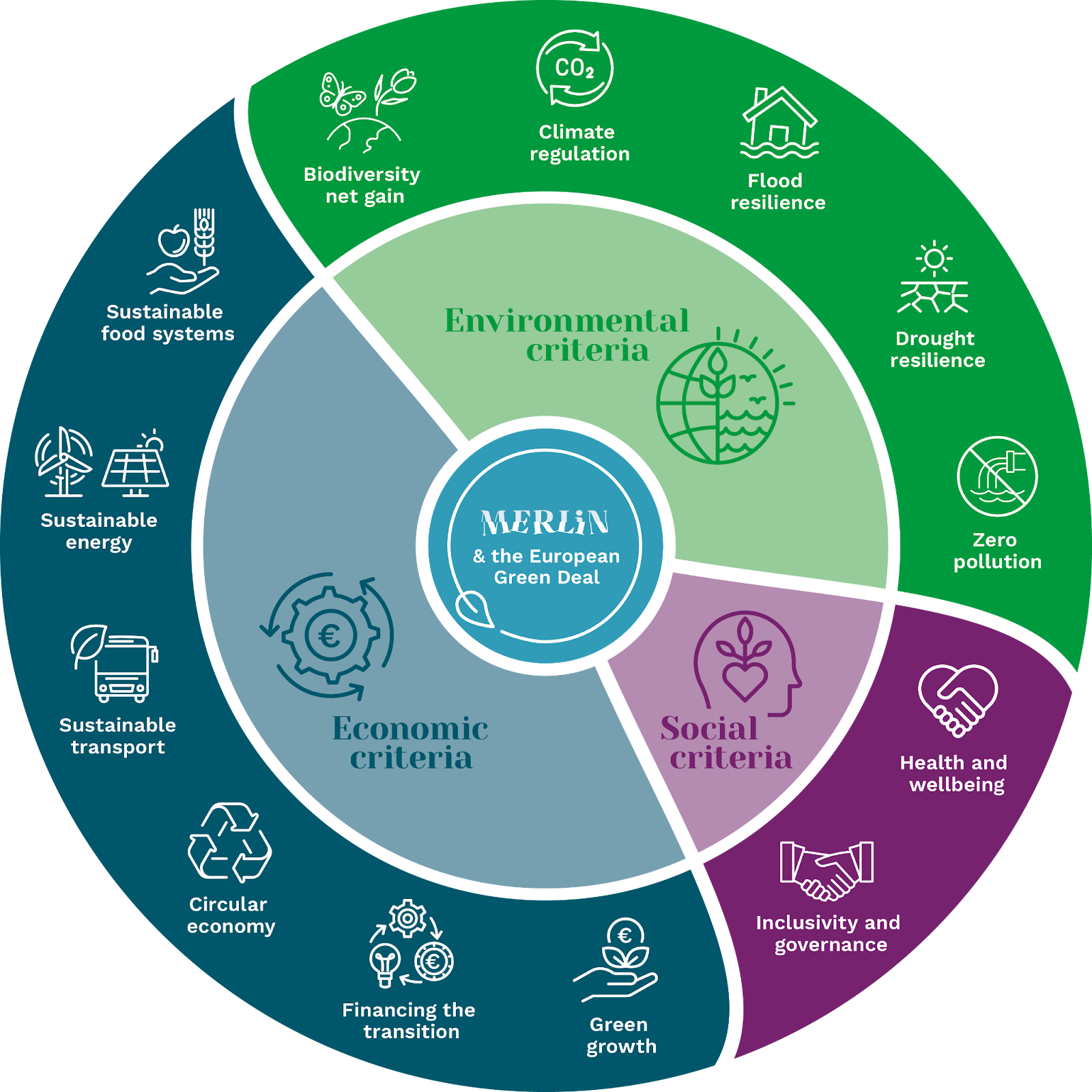
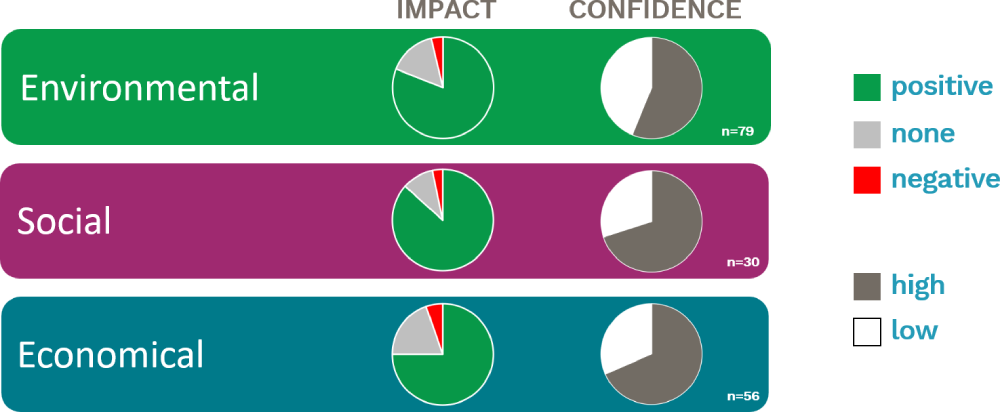
The MERLIN impact monitoring results reported by the 18 case studies for the 13 EU Green Deal criteria were subjected to an aggregated assessment. Additionally, the case studies anticipated impacts aligned with the Nature-based Solution (NbS) objectives by applying a Theory of Change (ToC). Together, the ToC and monitoring constitute integral components of a broader adaptive management strategy that is essential for effective NbS implementation.
The table below presents the monitoring results (visualized by Smiley faces) in relation to the restoration impacts anticipated in the ToCs of the individual case studies. The background colour of the cells corresponds to the Theory of Change categories:
- dark blue indicates a primary restoration goal
- medium blue a secondary goal
- light blue a restoration co-benefit
- white denotes not relevant
Case Study 18 did not provide any information on the Theory of Change.
Note: More information regarding the study sites is provided in Annex 1 of MERLIN Deliverable D1.6 "Manuscript and policy briefing evaluating success of large landscape-scale restoration". For case studies reporting data for a given criterion for more than one implementation site, the respective sites are denoted by lower case letters:
- Emscher basin-scale DE (CS11)
- Emscher Lake Phoenix DE (CS11)
- Emscher flood-basins DE (CS11)
- Emscher mouth DE (CS11)
- Riparian buffer strips BE (CS16)
- Zwalm restoration BE (CS16)
- Read more about the scoring of the monitoring results including an explanation of the Smiley faces
- An example of application of the monitoring results is provided based on the Tisza floodplain rewetting demonstration case study, with interactions across the EU Green Deal Criteria inferred from the results.
 to read more about the case study assessment (where available).
 to go to the case study data in Zenodo.
| Case study | Biodiversity net gain
|
Climate regulation
|
Flood resilience
|
Drought resilience
|
Health & well-being
|
Zero pollution
|
Farm to fork
|
Sustainable energy
|
Sustainable transport
|
Inclusivity and governance
|
Circular economy
|
Financing the transition
|
Green growth
|
|---|---|---|---|---|---|---|---|---|---|---|---|---|---|
| Peatlands and wetlands | |||||||||||||
| CS01 — Kvorning wetland rewetting DK |  |
NA | |
|
|
NA | NA | NA | NA |  |
NA | |
|
| CS03 — Beaver river engineering SE | |
 |
|
 |
|
 |
NA | NA | NA | |
|
|
|
| CS05 — Kampinos wetland rewetting PL | |
|
|
|
|
|
NA | NA | NA | |
NA | |
|
| CS06 - Hutovo Blato peatland rewetting BiH | |
NA | NA | NA | |
NA | NA | |
|
|
|
|
|
| CS12 — Lima floodplain forest restoration PT | |
|
|
|
|
|
 |
|
NA | |
|
|
|
| CS14 — Komppasuo peatland rewetting FI | |
|
|
|
|
|
NA | NA | NA | |
NA | |
|
| Small streams and basins | |||||||||||||
| CS02 — Deba barrier removal ES | |
|
|
|
|
|
NA | |
NA | NA | NA | NA | NA |
| CS11 — Emscher basin restoration DE | a |
|
|
|
|
|
NA | |
NA | a |
NA | b c d
|
|
| CS13 — Sorraia river restoration PT | |
 |
|
|
 |
NA | NA | NA | NA | |
|
NA | |
| CS15 — Tzipori basin restoration IL | |
|
|
|
|
NA | |
NA | NA | |
NA | |
|
| CS16 — Upper Scheldt restoration BE | f |
|
|
|
e f
|
e |
e |
e f
|
NA | |
|
|
e f
|
| CS17 — Forth basin restoration UK | |
|
|
|
|
NA | |
NA |  |
|
NA | |
|
| CS18 — Ervidel river restoration PT | |
|
|
|
|
NA | NA | NA | NA | |
|
|
|
| Large transboundary rivers | |||||||||||||
| CS04 — Room for the Rhine NL | |
|
NA | NA | NA | |
|
NA | NA | NA | NA | NA | NA |
| CS07a — Danube floodplain restoration AT | |
|
|
|
NA | NA | NA | NA | NA | |
NA | |
|
| CS07b — Danube sidearm reconnect HU | |
|
|
|
NA | NA | |
NA | NA | NA | NA | |
|
| CS08 — Danube floodplain reconnect RO | |
|
|
|
|
|
NA | NA | NA | |
NA | |
|
| CS09 — Tisza floodplain rewetting HU | |
|
|
|
|
NA | |
NA | NA | NA | |
|
|
| CS10 — Blue Belt Germany DE | |
|
|
|
|
|
|
NA | |
|
NA | |
|
Smiley faces explanation
Negative impact
- - Clear evidence of deterioration.
- - Indications of deterioration, but data are ambiguous (e.g. fluctuating trends).
No impact/irrelevant impact:
- - No detectable change, with stable data or narratives confirming the absence of change.
- - No significant change, but less precise evidence.
Positive impact
- - Clear evidence of improvement, supported by consistent data or positive narratives.
- - Indications of improvement, but data are ambiguous (e.g. fluctuating trends)
- - Effects could not be assessed due to lack of data or lack of response time.
- - Effects remain uncertain or inconclusive.
No data. NA - Indicator is not relevant to that CS or data was not reported for other reasons.